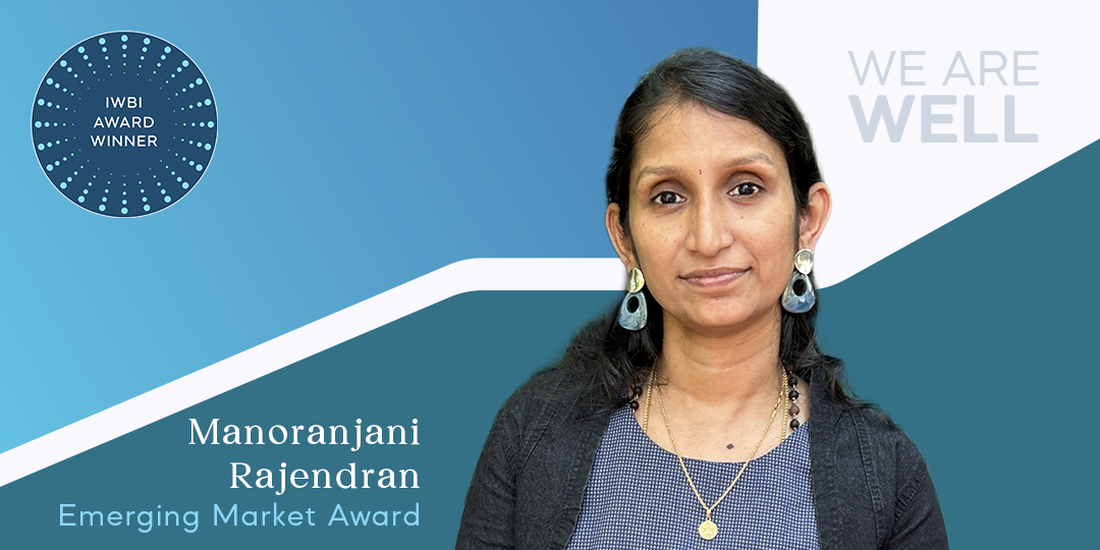
Placing people at the center: How Manoranjani Rajendran transforms building design into organizational culture
As Senior Projects Head at En3 and recipient of the 2025 WELL Emerging Market Award, practicing architect Manoranjani Rajendran leverages her WELL AP credential to bridge design intent with operational reality across global portfolios.
For Manoranjani Rajendran, true wellness in the built environment isn’t merely designed—it must be implemented, managed, and experienced every single day. Since earning her WELL AP credential in 2018, the practicing architect and LEED Fellow has spearheaded sustainable design across more than 250 projects and 15 WELL at scale portfolios at En3. Recognized with the 2025 WELL Emerging Market Award, Manoranjani brings together design teams, HR leaders, and facility managers to embed health into organizational strategy.
How did you first hear about the WELL AP? What made you interested in the credential?
I first learned about the WELL AP credential through my work in sustainable building projects alongside LEED certifications in the year 2015 . I was particularly interested in WELL’s people-centric approach, focusing on health and well-being in design and construction. It aligned perfectly with my goal of delivering holistic, high-performance spaces.
What’s one way becoming a WELL AP has impacted your life and/or career?
As an Architect & Sustainability consultant, becoming a WELL AP gave me a global platform for international recognition and transformed our design philosophy—placing human health and wellness at the very heart of every space we create.
What are some things you’ve been able to do (or you plan to do) as a WELL AP you couldn’t before? Why are those things important to you?
As a WELL AP, my role now extends beyond building design — it enables meaningful collaboration with HR, facilities, and leadership teams to translate wellness goals into real, measurable impact.
-
It has allowed me to bridge design intent with operational reality, ensuring that the envisioned health and well-being outcomes are truly experienced by occupants.
-
This is important to me because true wellness is not just designed — it is implemented, managed, and lived every day within the space.
Did anything about the WELL AP process surprise you—from registering for the exam to your experience post-accreditation? What was it? How would you prepare WELL AP candidates for that?
What surprised me most about the WELL AP process was the depth of integration it demands — it is not simply an exam based on technical requirements, but a comprehensive framework that connects design, operations, and human behaviour in a wholistic manner.
From registration through post-accreditation, I realized that success lies in understanding the intent behind each concept and how those strategies are implemented across disciplines. The most significant shift post-accreditation was the expanded professional responsibility — stakeholders view a WELL AP as a strategic advisor on health and well-being, not just a certification specialist.
For aspiring candidates, I would recommend to:
-
Focus on the intent and application of each feature, not rote memorization.
-
Relate concepts to real-world project scenarios and operational practices.
-
Develop an interdisciplinary perspective, considering collaboration with HR, facilities, and leadership teams.
Approaching the credential with this holistic mindset makes both the examination and professional impact far more meaningful.
What’s something about the WELL AP—or the WELL movement in general—that isn’t often discussed, but you think deserves more attention
An aspect of the WELL AP credential and the broader WELL movement that warrants greater attention is its capacity to influence organizational strategy and culture — not merely building performance metrics.
While discussions often center on certification levels and technical requirements, the true value of WELL lies in its ability to align leadership, human resources, facilities, and design teams around a unified health and well-being agenda. It elevates wellness from a design feature to a core business priority.
In essence, WELL is not simply a rating system; it is a framework for institutionalizing health as a measurable, long-term organizational commitment — and that cultural transformation is its most powerful yet under-recognized impact.
Do you have any advice you’d give potential WELL AP candidates?
My advice is the “believe in yourself”. Approach the WELL AP with a clear understanding of intent, not just technical requirements. Study each concept in the context of real-world design and operational scenarios. Think beyond architecture — consider collaboration with HR, facilities, and leadership teams. Most importantly, see the credential as a platform for leadership in advancing health and well-being.
What does well-being mean to you? How do you incorporate it into your life and routine?
As an architect and WELL consultant’s perspective, well-being represents the integration of health, comfort, performance, and environmental responsibility within the built environment. It extends beyond aesthetics and functionality to creating spaces that actively enhance physical health, mental clarity, and emotional balance.
I view well-being as a measurable and design-driven outcome—shaped by air quality, daylight access, thermal comfort, acoustics, material selection, and spatial planning. In practice, I incorporate these principles by prioritizing evidence-based design strategies aligned with WELL standards and sustainable frameworks.
Personally, I apply the same philosophy to my routine by maintaining structured work-life balance, exposure to natural light, mindful scheduling, and continuous professional development. I consciously choose healthy indoor environments and ergonomic settings that support productivity and focus.
For me, well-being is both a design mandate and a leadership responsibility—ensuring that every space we influence contributes positively to human health while supporting long-term environmental sustainability.
Is there a specific WELL concept, feature or set of features that have really resonated with you and that you’ve incorporated into your own life?
Yes — the Mind and Air concepts have resonated deeply with me.
The emphasis on mental well-being, biophilia, and restorative spaces has influenced how I structure my own work routines and prioritize balance. Similarly, the focus on indoor air quality has made me more conscious about ventilation, filtration, and healthy indoor environments in my personal spaces.
These concepts reinforced for me that wellness is not just a design strategy — it is a daily focus.
What projects do you have planned for the future? How will your WELL AP credential support the project’s success?
At En3, we are advancing a portfolio of future-ready commercial and workplace projects that integrate sustainability and wellness strategies from the earliest design stages. We are also expanding our engagement with WELL at Scale accounts to embed health and well-being across organizational portfolios rather than isolated assets.
Our goal is to align these developments with global benchmarks such as LEED and WELL, ensuring high-performance outcomes that address environmental responsibility alongside occupant health.
My WELL AP credential enables early-stage integration of evidence-based health strategies into planning, design, and operational frameworks. It strengthens cross-functional collaboration among architects, engineers, HR teams, and facility managers to ensure measurable well-being outcomes.
Is there anything else you’d like to share?
I strongly believe that the future of architecture lies in integrating sustainability, technology, and human well-being as a unified design approach rather than separate objectives. As professionals, we carry the responsibility of shaping environments that positively influence how people live, work, and interact.
Continuous learning, interdisciplinary collaboration, and measurable performance outcomes are essential to advancing this vision. I am committed to contributing to knowledge-sharing platforms, mentoring emerging professionals, and promoting evidence-based design practices that prioritize both planetary and human health.
Ultimately, well-designed spaces should not only reduce environmental impact but also elevate the quality of life for the communities they serve.
Learn more about what it takes to become a WELL AP!