Why WELL Stands Alone: Validated by Independent Research No Other Program Has

As the global conversation on healthy buildings accelerates, organizations increasingly look for standards they can trust. The WELL Building Standard is uniquely backed by the most robust body of independent, peer-reviewed research from leading research institutions around the world validating its effectiveness in improving health, well-being, satisfaction, real estate value and performance. These studies provide scientifically backed evidence of WELL buildings leading to positive real estate and human performance outcomes.
Together, these studies form a deep and expansive body of evidence showing that WELL delivers measurable benefits to people and organizations alike. This unprecedented body of research showing such strong, consistent and positive findings sets WELL apart. There’s simply no comparison.
Here is what the research shows:
-
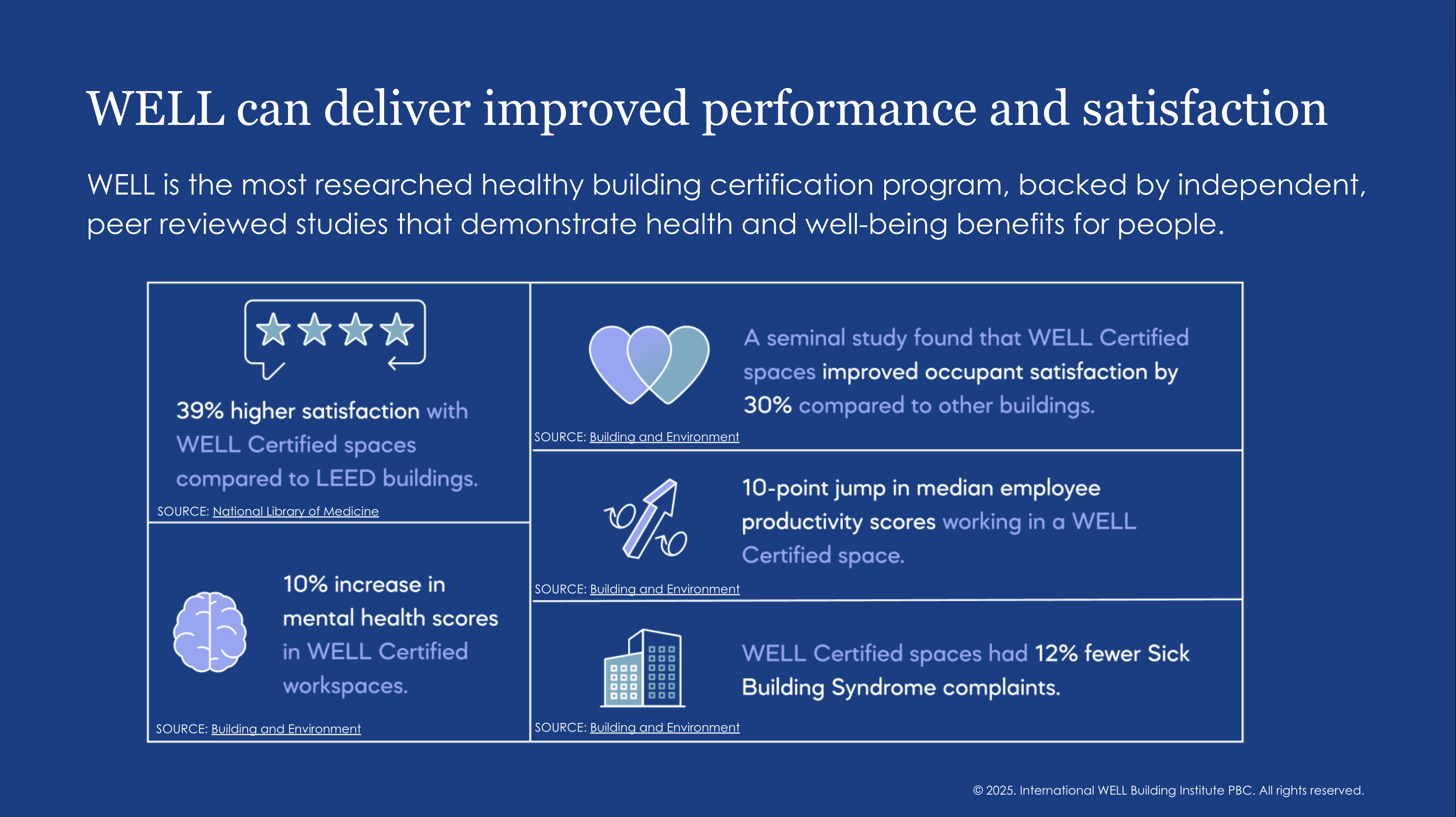
Increased Occupant Satisfaction: WELL Certified buildings led to increased occupant satisfaction by nearly 30%. (1)
-
Boosted Productivity: WELL Certified buildings boosted productivity scores by 10 median points. (2)
-
Enhanced Well-Being: WELL Certified buildings led to improvements in occupant well-being scores by 26%. (3)
-
Improved Mental Health: WELL Certified Buildings led to improved reported mental health by 10%. (4)
-
Achieved Rent Premium: WELL Certified buildings achieved 4% to 7% rent premiums and higher tenant demand. (5)
-
Longer Lease Terms: Healthy buildings certified under WELL yielded lease terms more than a year longer. (6)
-
Greater Satisfaction Over Non-Certified Buildings: WELL Certified buildings report significantly higher employee satisfaction compared to non-WELL Certified high-performance buildings, including: 18% more satisfied with access to sunlight, 17% more satisfied with acoustical privacy, 16% more satisfied with connection to the outdoor environment, 12% more satisfied with lighting, 11% more satisfied with thermal comfort and 10% more satisfied with both indoor air quality and air movement. (7)
-
More Satisfaction Over Green Buildings: Occupants in WELL Certified buildings are 39% more likely to report satisfaction with the building compared to those in LEED green-certified buildings. (8)
-
Fewer Health Complaints Over Non-Certified Buildings: WELL Certified buildings reported 12% fewer Sick Building Syndrome complaints and 6% fewer musculoskeletal complaints. (9)
Taken together, this research makes the conclusion clear that the WELL healthy building certification system is in a class of its own as being backed by independent, peer-reviewed evidence demonstrating significant benefits for people, workplaces and organizations. As the title says, WELL stands alone. It’s the only healthy building certification in the world with this unmatched level of independent, peer-reviewed evidence that shows it helps people thrive, strengthens organizations and creates market advantage.
SOURCES
- Ildiri, N., Bazille, H., Lou, Y., Hinkelman, K., Gray, W. A., & Zuo, W. (2022). Impact of WELL certification on occupant satisfaction and perceived health, well-being, and productivity: A multi-office pre- versus post-occupancy evaluation. Building and Environment, 224, Article 109539. https://doi.org/10.1016/j.buildenv.2022.109539.
- Ibid.
- Ibid.
- Ibid.
- Sadikin, N., Turan, I., & Chegut, A. (2021). The financial impact of healthy buildings: Rental prices and market dynamics in commercial office. MIT Center for Real Estate Research. http://dx.doi.org/10.2139/ ssrn.3784779.
- Ibid.
- Marzban, S., Candido, C., Avazpour, B., Mackey, M., Zhang, F., Engelen, L., Tjondronegoro, D. (2023). The potential of high-performance workplaces for boosting worker productivity, health, and creativity: A comparison between WELL and non-WELL certified environments. Building and Environment.
https://www.sciencedirect.com/science/article/pii/S0360132323007357. - Kent MG, Parkinson T, Schiavon S. Indoor environmental quality in WELL-certified and LEED-certified buildings. SciRep. 2024 Jul 2;14(1):15120. doi: 10.1038/s41598-024-65768-w. PMID: 38956287; PMCID: PMC11220045.
https://www.sciencedirect.com/science/article/pii/S0360132323007357. - Marzban, S., Candido, C., Avazpour, B., Mackey, M., Zhang, F., Engelen, L., Tjondronegoro, D. (2023). The potential of high-performance workplaces for boosting worker productivity, health, and creativity: A comparison between WELL and non-WELL certified environments. Building and Environment.
https://www.sciencedirect.com/science/article/pii/S0360132323007357.