
A first look at the next version
Public comment now open through May 1 2026.

Welcome to a first look at the next version of WELL. This is a debut of our updated and integrated WELL Standard, which sits at the core of all that we do. Following a year of in-depth conversation with the community, we could not be more excited to share this draft with you. The updates within have been shaped by feedback from our global network of project teams and reviewers, and we hope that you see how your input has been incorporated throughout the draft. We now invite you to preview the changes and share your feedback through public comment now open through May 1, 2026.
If you haven’t yet explored our page outlining our One WELL vision, please do! This article builds upon those foundation-setting details and explains how we are realizing this vision through the new version of the standard. It summarizes proposed changes related to various language, scoring and program rules, changes that will take effect within the WELL Program Guidebook once we open enrollment later this year.
Participate in Public Comment
Community feedback is at the heart of what informs the evolution of WELL and we are inviting you to continue to shape what’s possible. During the public comment period, you’ll have the opportunity to review and provide feedback on:
-
Clarified WELL strategy language and structure
-
The standard’s new design, layout and functionality
-
The program changes summarized in this article
The public comment period is an opportunity for you to provide feedback on the new version of the WELL Standard in its current draft form. As part of the finalization process, we will work to address feedback and polish everything before we open it for enrollment. In the meantime, please refrain from commenting on spelling, grammar, and punctuation – that level of refinement will occur in the next phase.
We’ve reimagined the public comment experience from the ground up — with side-by-side comparisons of WELL v2 and a digital changelog that highlights what’s evolved, as well as an interactive feedback widget that makes it easier than ever to share your feedback.
Provide your input by May 1, 2026. Get started now.
We also invite you to join the conversation on the WELL Forum, where we’ll ask for pointed input on specific changes, share additional updates for discussion and keep you informed of how the multi-phase development process for One WELL is progressing.
The WELL Standard at glance
The new version of the WELL Standard incorporates a refreshed layout, updated hierarchy and new terminology. Here are the layers of hierarchy you can expect to navigate when exploring the next version of WELL:
-
The same dependable 10 WELL Concepts, plus Innovation.
-
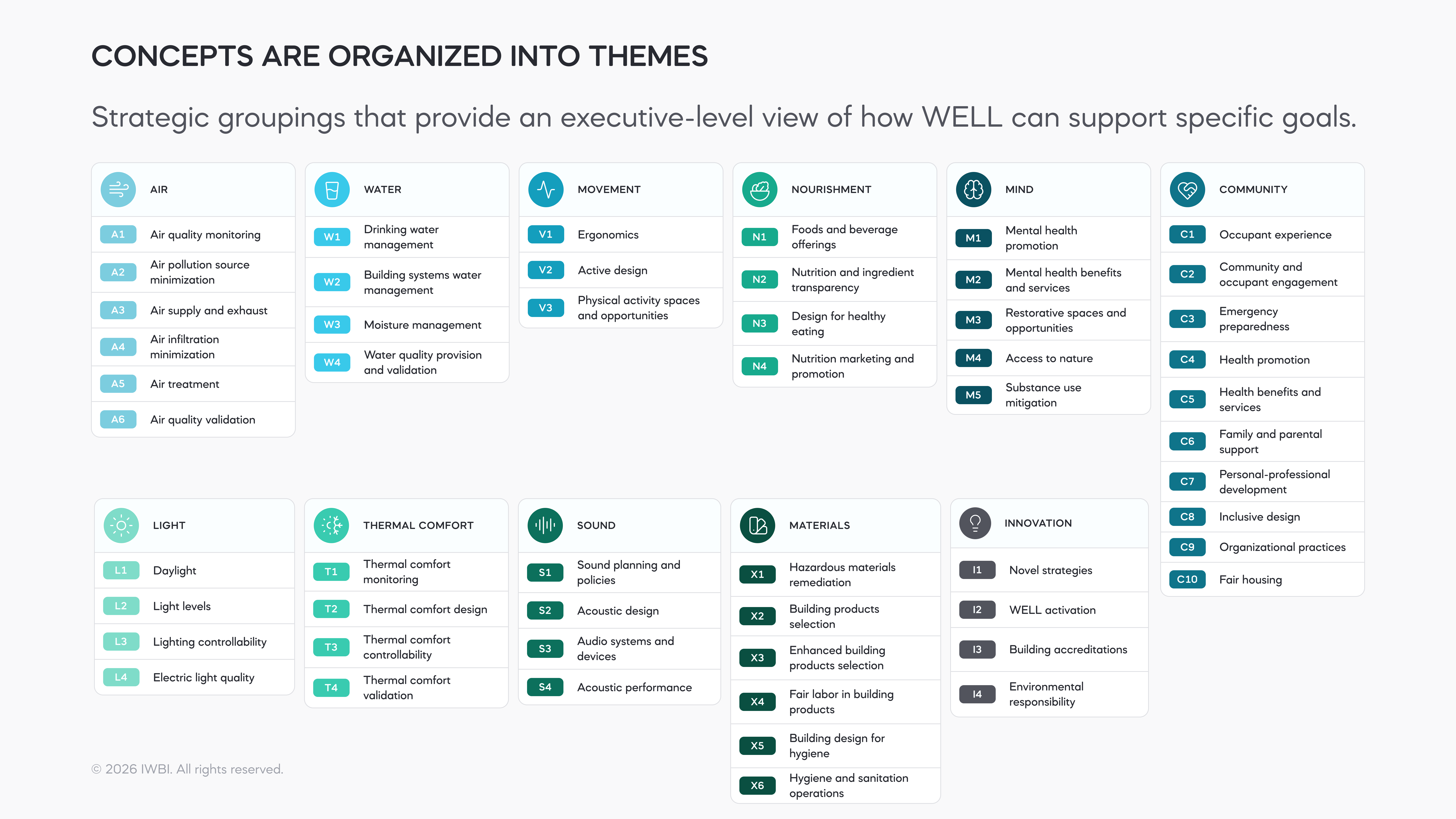
54 Themes (previously WELL features): Groupings of WELL strategies that provide an intuitive, executive-level view of the categories of interventions within each concept, making it easy to pinpoint relevant strategies.
-
212 Strategies (previously WELL feature parts): Evidence-based health and well-being interventions that, when validated, contribute to WELL achievements. All strategies result in points, even the required preconditions for certification.
A birds-eye view of all 54 Themes in the WELL Standard
Dive deeper with our Head of Design Andre Poremski for a tour of the new WELL Standard experience.
Our vision for One WELL
The power of WELL comes from our comprehensive library of evidence-based interventions. Today, there are more ways than ever for organizations to implement WELL strategies, deliver on business goals and earn recognition through certification and rating achievements.
That’s why our first release in a series of enhancements that are part of One WELL is a preview of the next version of the WELL Standard. Through clearer language, elevated design and unified program rules, we are delivering on our commitment to make the WELL journey more efficient and impactful. But this is just the beginning. As we work towards opening enrollment, imagine an experience that is more intuitive to navigate, more connected and more rewarding at every step of the journey. That’s what we’ve been building and this preview offers you a first look. All of the changes summarized below will be reflected in an updated version of the WELL Program Guidebook, which will be published when we open enrollment.
Harmonized
Single unified library of strategies with filtering to see how strategies contribute to specific WELL achievements.
-
Strategies from WELL Ratings, WELL v2 and select strategies from WELL for residential have been harmonized and compiled in one unified standard.
-
The remaining strategies from WELL for residential will be incorporated prior to enrollment, and we plan to integrate strategies from the WELL Community Standard over time.
-
We also plan to expand filtering options to include additional business goals and priorities to provide a more advanced experience to help clients pinpoint the strategies that matter most.
A new theming and consolidated structure that organizes WELL strategies into intuitive groupings, providing a more scannable experience.
-
First and foremost, theming allows related strategies to be easily assessed and compared alongside one another, instead of being listed in different positions throughout the concept. For example, within the Community Concept, strategies related to emergency preparedness were previously designated as C03, C14 and C15. In the new version of WELL, they are all grouped under one theme.
-
Additionally, a consolidation of strategies related to the same health intent allows the basic and enhanced pathways to be considered together, instead of being listed separately spanning both a “precondition” and an “optimization.” For example, within the Air concept, the thresholds for particulate matter were previously listed in A01.1 and A05.1. In the new version of WELL, they are grouped together in strategy A6.1 as three tiers.
Consistent strategy names, requirements, point values and scoring to streamline how projects can make progress towards various WELL achievements.
-
All strategy names and requirement language are exactly the same across all WELL achievements and benchmarks, including WELL Ratings, WELL Certification and the WELL Score.
-
To align scoring methodology, all strategies have been assigned points based on the strength of the evidence supporting them. Points are the same across all WELL achievements. Preconditions, which are required for WELL Certification now qualify for points across the board. These scoring improvements help ensure that every point earned toward a rating is now a point earned toward certification.
For enrollment:
-
The certification requirements for each concept will be explained with a list of ‘preconditions’ for WELL Certification and the concept point minimums.
-
The minimum number of points required for WELL Certification levels will be adjusted to reflect that preconditions now have points.
-
The minimum number of points required for WELL Ratings will be adjusted to reflect changes made to strategy points and the combination of certain requirements (e.g., WELL v2 Feature Parts A01.1 and A01.2, which cover indoor and outdoor smoking bans, were combined into a single strategy).
-
The WELL Score calculation will be updated to reflect that preconditions now have points. Additionally, the 49-point cap for locations that have not achieved preconditions will be removed, enabling better recognition of the incremental achievement of foundational health and well-being strategies.
Increased recognition of achievement within each concept to accelerate your impact.
- Caps that previously limited concept achievements to a maximum of 12 points per concept will be removed, affording more ways to earn the points needed for each level of WELL Certification.
Clarified
Informed by extensive feedback from WELL clients and reviewers, we’ve restructured and simplified how all WELL strategies are written, making them more clear, scannable and straightforward to implement. These are the same WELL strategies you know and trust - underscored by a rigorous body of research.
As part of our clarity edits, we also reviewed feedback from project teams and reviewers about feasibility and impact. This resulted in additional changes that expand the ways in which you can comply, remove criteria to emphasize what’s most important to the health intent and improve specificity to address instances of misinterpretation. The next version of WELL includes more instances where strategies have been updated to be more stringent than a typical addenda. These changes reflect an elevated standard for health leadership, a trend that is not expected to be as frequent in future updates.
The changes range from:
Simplified language and structure: all strategies
-
Utilized more direct and precise strategy language to make it more clear what needs to be done to achieve each strategy.
-
Elevated minimum scope and applicability of each strategy, to emphasize critical information about eligibility and implementation.
-
Introduced bulleted lists to increase scannability and to clearly distinguish separate requirements.
Expanded pathways to offer more flexibility
- For example, WELL v2 Feature Part V08.1 [new code V3.2] includes a new tier inspired by the WELL for Residential program that rewards projects for implementing accessible fitness spaces.
Reduced scopes to address market feasibility
- For example, WELL v2 Feature Part M09.2 [new code M4.2] no longer includes a policy-based requirement for nature access to reduce complexity and emphasize criteria that is most critical to the health intent.
Clarified language to avoid misinterpretation
- For example, WELL v2 Feature Part N02.1 [new code N2.1] confirms that projects must actively prepare food on-site to be eligible to earn this strategy.
Increased stringency to reflect updated evidence on what constitutes health leadership. Primarily, the types of changes you can expect to see in this category include:
-
A revised a threshold that is more stringent
-
The addition of new requirements
-
An adjusted scope that is more expansive
-
In cases where a strategy reflects additional stringency, clients will have access to an “existing legacy pathway” allowing them to utilize legacy feature language for a period of three years starting from the date on which we open for enrollment. After the expiration of the legacy pathway, clients would need to submit updated documentation reflecting compliance with updated requirements or remove the feature from their scorecard.
-
For example, WELL v2 Feature Part A05.1 Tier 2 [new code A6.1 Tier 3] includes a lower thresholds for PM2.5 (5 ug/m3 compared to 10) and PM10 (15 ug/m3 compared to 20), based on updated air quality guidelines from the World Health Organization (WHO).
Note that citations and strategy background information was not incorporated into the current draft. Because every strategy in the new version has a corollary feature in WELL v2, citations and background information from WELL v2 remain relevant. Use the ‘compare to WELL v2’ view to see these citations and feature backgrounds in WELL v2 as needed. At enrollment, citations and strategy background information will be fully incorporated into the new WELL Standard.
Evergreen
Just like an evergreen tree, the WELL Standard has always gone through surges of new growth every year as science and best-practice evolves.
The evergreen addenda approach prioritizes gradual enhancement over restructuring, letting you manage all of your projects within the same version of WELL, one that reflects the latest improvements as they are published over time.
For enrollment:
-
All enrolled locations utilize the same version of the WELL Standard.
-
The scorecard automatically updates when we make updates to WELL.
-
An updated user experience and digital changelog provides a clear summary of what changed and why.
-
For the majority of changes that make WELL more flexible, feasible and easier to understand, application of older iterations of the standard still comply. It is acceptable to submit documentation based on an earlier iteration.
-
Then, while we rarely make WELL more difficult to achieve, when we do, it’s your choice whether to incorporate that change. The legacy strategy language can be used for three years after a more stringent requirement is published.
Smarter
Each of the changes described above — the harmonization, the clarifications, and the evergreen model — solves a real problem on its own. But together, they create something larger: the foundation for a fundamentally different kind of WELL experience.
When every location shares one standard, one scoring system and one living version, we can deliver what was previously impossible:
-
Dynamic scorecards that adapt to your workflow and stage of development
-
Built-in intelligence that shows how progress on one achievement advances others
-
Personalized guidance toward your next milestone, informed by where you are today.
-
Granular permissions so team members see only what’s relevant to their role
-
Streamlined file sharing and documentation management across a portfolio
-
And so much more
This same unified infrastructure opens the door to expanding how WELL recognizes achievement. With streamlined naming, consistent point values, and a coherent architecture, we can more easily create targeted pathways with different goals and audiences over time — meeting more organizations where they are on their health journey.
These platform and program enhancements are coming in future phases but the standard changes you are previewing now are what make them possible.
Join the WELL Forum to stay up to date on key enhancements to the WELL platform.
Areas Under Development
One WELL is being developed in phases, starting with a preview of the new version of the WELL Standard and public comment and moving toward open enrollment with continuous enhancements along the way. For the preview and public comment period, the following aspects of WELL are not finalized:
-
Enrollment options, processes and pricing
-
Verification methods, documentation templates, forms and calculators
-
FAQs and Alternative pathways including AAPs and Crosswalks
-
Metric conversion between Imperial and Metric (International System of Units)
-
Criteria citations and background information for WELL Strategies and Concepts
-
Migration from older versions of WELL to the new version
-
Support resources, articles and technical tools
We will continue to provide updates on these developments. As always, thank you for being on this journey with us.


